
Safeguarding Child Exploitation Multi-Agency Framework
Amendment
This policy is intended to be used by social workers and other local authority staff who are responsible for assessing need and providing support to families who may be impacted by Child Exploitation.
This policy is intended to be used by social workers and other local authority staff who are responsible for assessing need and providing support to families who may be impacted by Child Exploitation.
The Multi Agency Youth Violence Exploitation (MAYVE) framework explains arrangements in Hull for responding to the challenge of children vulnerable to exploitation, including child sexual exploitation (CSE); those who go missing and other forms of abuse such as child criminal exploitation (CCE) and trafficking.
The arrangements where refreshed and replace the previous Multi-Agency Child Exploitation (MACE) framework and have resulted in the MAYVE framework. The MAYVE framework promotes a multi-agency approach that responds to the government objectives outlined in Hull All Age Exploitation Strategy 2025 - 2027 which are:
- Adopt a principle of continued multi-agency prevention of exploitation, and early intervention;
- Multi-agency sharing of information in a timely manner;
- Taking a holistic and contextual approach to individuals, rather than concentrating on risks, incidents and indicators;
- Ensuring that young adults aged 18+ continue to receive services to support their safe transition to adulthood;
- Not criminalising victims;
- Giving consideration to the impact of trauma and providing support to victims in rebuilding a sense of control and empowerment.
We are committed to protecting children, adults, and their communities, from all types of exploitation. We recognise we have much to do to ensure that we deliver a consistently robust and integrated response to children, young people, and adults at risk of exploitation. There is a constantly evolving landscape in relation to all forms of exploitation, compounded by advances in technology which has contributed to the increased risks of on-line exploitation.
There is a strong collective commitment to identify exploitation at the earliest opportunity and to ensure that individuals, their families, and support networks access the right services at the right time. This collaborative `Hull All Age Exploitation Strategy' outlines our joint partnership approach to tackling exploitation and is intended for all agencies and professionals working to safeguard and prevent harm to adults and children. It is essential that all partners working with people at risk, and the wider public, understand what exploitation is, and how to respond to concerns.
Our ambition is to provide a collaborative partnership response to exploitation through identifying and protecting those at risk of exploitation; strengthening the resilience of people and communities; supporting people who have experienced exploitation in their recovery; and pursuing those who perpetrate exploitation and bring them to justice. Equally as important is our focus on early intervention work and the prevention of exploitation. This is detailed in Hull's Contextual Safeguarding Strategy 2023 - 2026 and Working together to safeguard children 2023: statutory guidance.
Sexual Exploitation - such as prostitution, online sexual services, web camming, pornography, other forms of commercial sexual exploitation.
Criminal Exploitation - drug dealing or transportation (county lines), petty crime such as shoplifting, burglary, benefit and other types of fraud, begging, cannabis cultivation, sham marriage, sham adoptions Organ Removal, illegal purchase, sale or theft of organs.
Labour Exploitation - agriculture, seafood/ fishing industry, car washes, restaurants/ takeaways, hospitality, construction, factories, delivery drivers and agency work are common sectors where people are exploited for their labour.
Domestic Servitude - Staff living and working on premises of a family home, usually with little to no time off, limited food provided, no comfortable/private place to sleep, in exploitative conditions.
Young people and adults can be trafficked for multiple types of exploitation, either simultaneously, or consecutively, such as labour exploitation in nail bars and sexual exploitation at the same time or being moved on from sexual exploitation to cannabis cultivation.
This Policy must:
Be compliant with The Children Act 1989, statutory guidance, and findings made by the courts relating to the provision of financial support under section 17. Be consistent with the local authority's corporate priorities and values:
- Safe and welcoming neighbourhoods;
- A healthier and fairer Hull;
- Reaching our potential;
- Economic growth that works for all;
- Responding to the climate and nature emergency;
- Our culture, our heritage, our city.
Safeguarding children is everyone's responsibility. We all have the ability to transform lives by working together with, and for families. In doing so, we can bring about positive change to help children and families in the community flourish.
We have a whole system approach that exists across the Hull Safeguarding Children Partnership to provide additional support for children when this is needed. The guidance sets a revised and shared vision of providing help, support, and protection; 'The right support at the right time and from the right place'. HSCP 2024 Threshold Guidance.
In Hull, we want to be ambitious for all children, so they feel safe, happy, healthy, and able to achieve whilst ensuring children are protected from abuse and neglect. It is crucial that practitioners have good communication and exercise professional curiosity at all times.
All practitioners have a shared responsibility and should use their safeguarding leads and consultations with the Early Help and Safeguarding Hub (EHaSH) for support, guidance, and reflection. Protecting children can be complex which is why a multi-agency approach is essential and is fundamentally required for achieving better outcomes for children. It will support practitioners regarding decision making and is aligned to Hull's chosen relationship-based model 'Signs of Safety'.
The newly revised guidance is central to delivering on the Department of Education Working together to safeguard children 2023 and the strategy set out in Stable Homes, Built on Love (2023) which outlines the Government's commitment to support every child to grow up in a safe, stable, and loving home.
Working Together to Safeguard Children (2023) and "Keeping Children Safe in Education" both refer to contextual safeguarding, which is all about how partners in Hull respond, understand, assess, and reduce the risk of harm outside the family home. This approach is all about taking a holistic view of the child's neighbourhood, school, peer groups, online space, as well as home environment. The work has also developed in line with the requirements in the Ofsted Inspection of Local Authority Children's Services (ILACS) Framework. The Strategy has clear links with a range of other strategies and plans, which drive our partnership work across Hull for children and young people:
- The Hull Youth Justice Plan;
- The Humberside Violence Prevention Strategy;
- Humberside Police Early Intervention Strategy;
- Safer Hull Community Safety Strategy;
- Hull Early Help and Prevention Strategy;
- Hull Contextual Safeguarding Strategy:
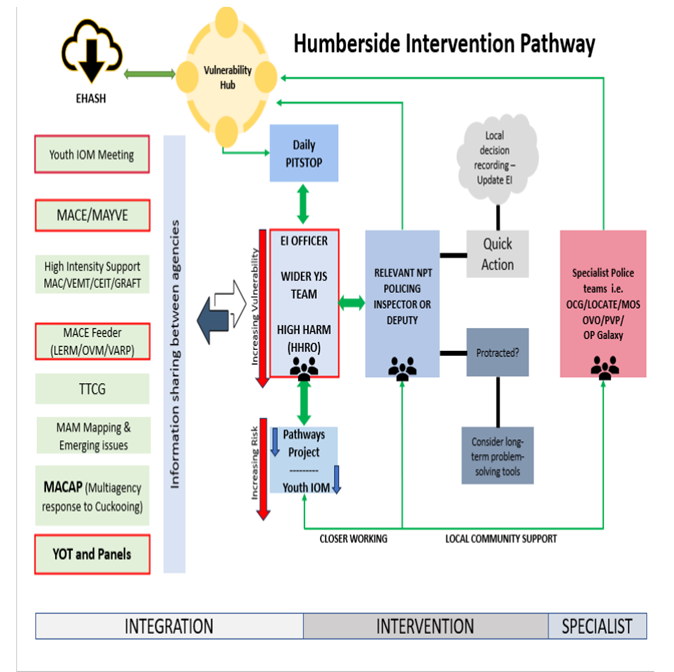
The Vulnerable, Exploited, Missing and Trafficked Team (VEMT) sits under the umbrella of the Early Help and Safeguarding Hub (EHASH) and Assessment Service and are based at Kenworthy House which is available to the public. This co-location ensures good communication between key services with regards to prevention and intervention for children and young people who are missing and where exploitation has been identified as a concern. The VEMT Team works closely with Humberside Police, including the Locate Team (missing children) and the Neighbourhood Policing Team (NPT), alongside Organised Crime Policing and The Modern-Day Slavery Policing Team (MDST).
The VEMT do not have case allocation responsibility, this sits with the allocated social worker or practitioner. However, they are instrumental and active participants in undertaking assessments of risk either through completing return home interviews (RHI's) or via any direct work with children and YP who go missing and/or are considered at risk of exploitation. The VEMT teamwork with children and young people to build relationships that enable trust and effective intervention. The intervention offered will look to empower the child and parents/carers by adopting a strengths-based approach to enable them to develop their own skills in risk identification and management. The team seeks to educate and to give young people the tools they need to recognise the warning signs, keep themselves safe and know how to report anything they are worried about.
The VEMT team undertake 3 tier mapping exercises for children and young people open to them and who are open to MACE processes:
- Tier 1 - Map completed with the child/young person to identify the area that they feel safe and where they feel most at risk;
- Tier 2 - Child's map is then taken to the multi-agency mapping meeting to determine plans and identify support and disruption needed;
- Tier 3 - Consideration given to the wider environment - strategic approach.
Referrals for direct work, advice and support for children/YP who go missing and/or are considered to be at risk of exploitation will be considered within one of 3 pathways:
- Emerging Risk - Intervention at the earliest stage when potential risk is first identified. This route will offer advice and support to children and their families with signposting to other services as appropriate including: MESMAC/Youth Services/Tigers Trust/REFRESH;
- Moderate Risk - Likely to require planned direct work, advice and support for the child and family/carers. May include allocation to or support from VEMT Youth Engagement Worker or Social Worker, Cornerhouse including CARE Project, HYJS for YP known to this service, REFRESH;
- Significant Risk - More intensive intervention required in relation to exploitation and other risks associated with going missing. Support that can be offered will be provided by a VEMT Social Worker or Cornerhouse CARE project and by HYJS for YP known to them where there is a CCE risk.
The Vulnerable, Exploited, Missing, Trafficked Team (VEMT) is committed to building relationships within the local community and with partners. The VEMT Team works alongside both internal and external partner agencies to offer a child centred and holistic approach to identify and support vulnerable children and young people who have been, or who are potential victims of exploitation.
The co-location of a youth engagement worker and two youth and community workers from the Youth Development Service strengthen and add capacity to the VEMT team. The youth workers specifically concentrate on Return Home Interview's (RHI's) and follow-up work, enabling young people to gain support to engage with community-based provision. Youth workers relate to the local communities of Hull and the broader provision which exists. Support can take the form of 'handholding' to youth provision, one to one support sessions and exploring issues as well as making appropriate referrals.
Hull Youth Justice Service attends the Locality Exploitation Risk Management (LERM) meetings and Multi-Agency Youth Violence Exploitation (MAYVE) Panel to ensure that information is shared in a timely manner and risk managed accordingly. When a young person has been referred to the Hull Youth Justice Service for criminal matters and child criminal exploitation is identified, the VEMT Team will work alongside the Youth Justice Officer and the allocated Social Worker to arrange completion of the RIT and NRM referral. When young people come to the attention of HYJS for diversion, the VEMT team offer support with additional resources and guidance.
Purpose
The purpose of LERM is to screen and discuss the current level of risk in relation to child exploitation and criminal exploitation. To support the disruption of activity and reduce risks and to decide on the level of risk; Low, Medium, or High.
- Low risk: close to MAYVE cycle, risks are being managed by Children's Social Care & partner agencies;
- Medium risk: close to MAYVE cycle, risks are being managed by Children Social Care and partner agencies. Panel will make a judgement about the current safety plan;
- High risk: progress to MAYVE for further oversight & disruption.
The Panel must receive the Risk Indicator Tool (RIT) prior to the meeting.
Once a concern has been identified that a child/young person is at risk of exploitation the allocated worker should complete the Exploitation (Child Sexual Exploitation/Criminal Exploitation) Risk Indicator Tool (RIT) and a CEVT (Child Vulnerability Exploitation Tracker).
In order to establish the level of risk. The Risk Indicator Tool is available on the Liquid Logic recording system and should be accessible to any practitioner who has access to the system. The Child Exploitation Vulnerability Tracker (CEVT) is an excel sheet which can be attached to Liquid Logic and can be sent by a member of VEMT. The VEMT Team offers advice around the completion of the RIT and CEVT.
Team Manager oversight is required on the RIT for children and young people, to ensure Social Care Managers are aware of the risks and any escalation, to ensure robust oversight and direction.
For cases being actively discussed at MAYVE, the Risk Indicator Tool should be reviewed and updated for every MAYVE cycle. A RIT can be completed and reviewed without being heard at LERM for lower risk young people, and the Social Care team manager can review this.
This enables the VEMT Team to maintain a clear picture of the number of children/young people vulnerable to exploitation and it enables monitoring of the effectiveness of the strategies that are being employed to reduce risk of harm and for consideration of alternative strategies in the event of the risk increasing.
The purpose of Multi-Agency Youth Violence Exploitation (MAYVE) Panel is a multiagency approach to reduce the risks associated with youth violence and exploitation which are intrinsically linked. This includes those at risk of harm, or who pose a risk of harm and ensures compliance with Safeguarding legislation, National Referral Mechanism, Integrated Offender Management (IOM) process, Serious Youth Violence Duty, Multi-Agency Public Protection Arrangements (MAPPA) guidelines, Youth Justice Board (YJB) Serious Youth Violence definition and local strategy Mayve one page briefing.
The panel requires agencies and professionals to work together with parents and children to alert them to the signs of grooming, exploitation, and county lines. This process enables broader agencies, outside of the statutory sector, to contribute to reducing the risk and impact of child exploitation on individuals, families, and communities. The panel will support the contextual safeguarding approach to risk management.
The meeting will offer an escalation process through the attendance of decision makers from the partnership and will monitor the demand for services and sufficiency of resources to meet needs and risks identified within this cohort, and delegate actions across the partnership.
The Panel encompasses professionals from LERM and additional representation Child Sexual Exploitation/Child Criminal Exploitation, Police Leads, British Transport Police, Health, MESMAC, Tiger's Trust, Refresh, Housing, Anti-Social Behaviour Team, The Warren.
Social Workers will attend when a child is receiving a service from them by way of Child in Need, Child Protection or Children in Care this is to ensure good case discussion.
Professionals who safeguard adults are also invited to attend Multi-Agencies Youth Violent Exploitation meeting (MAYVE), to provide support if there are vulnerable adults listed for discussion. Vulnerable adults are referred through via a RIT from the Leaving Care Social Care Team.
Planning will be done within the meeting and specific actions agreed and assigned to appropriate professionals.
The child will need to be presented for review at LERM to ensure that actions have been completed and with the purpose of increasing safety and protection.
Any risk reduction that results in LERM panel agreeing closure from the MAYVE cycle, need oversight from MAYVE panel.
Minutes are produced for both LERM & MAYVE and any actions to increase safety and protection agreed or completed at the meeting are updated on children's individual Risk Indicator Tools.
Any Adults discussed at MAYVE if continued oversight is required, they are included on the following MAYVE meeting until Closure is agreed. Panels consisting of Chair (co-chaired by Group Manager for the Assessment Service and Youth Justice Manager), Probation, Youth Justice, Education and Police as a minimum, and additional representation from internal and external partner support services. Social Workers will need to attend for case discussion for their child/young person.
To be eligible for discussion at MAYVE the child will fit into one or more of the following categories.
Considered a victim of CCE or CSE and through completion of a RIT and discussion at LERM - the risk to the child is assessed as high. Convicted of a serious youth violence category offence and managed by the Youth Justice Service (YJS) who consider the risk the child poses to others to be high referrals can only by submitted by the YJS. Referred via the NRM as a child victim of modern-day slavery.
In summary it seeks to identify and protect victims of exploitation by:
- Adopt a principle of continued multi-agency prevention of exploitation, and early intervention;
- Multi-agency sharing of information in a timely manner;
- Taking a holistic and contextual approach to individuals, rather than concentrating on risks, incidents and indicators;
- Ensuring that young adults aged 18+ continue to receive services to support their safe transition to adulthood;
- Not criminalising victims;
- Giving consideration to the impact of trauma and providing support to victims in rebuilding a sense of control and empowerment.
MAYVE meetings are held on the first Tuesday of every month, via TEAMS and will be chaired by Group Manager in children's social care and Youth Justice Manager.
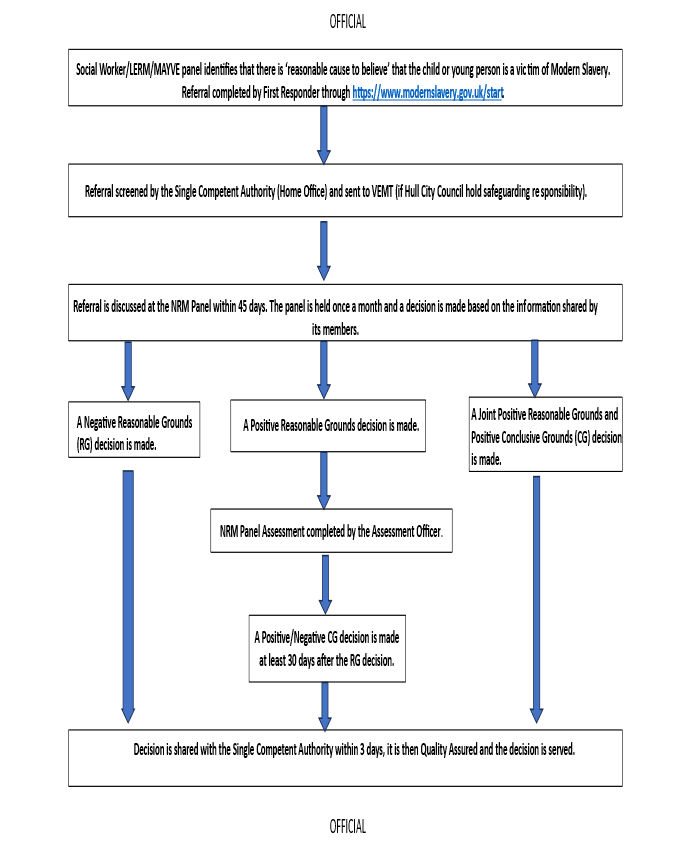
The National Referral Mechanism is the national framework for identifying and referring victims of modern slavery and ensuring they receive the appropriate support. The Single Competent Authority (SCA) administers it, which is part of the Home Office.
The profile of child victims are changing. UK national children are now the fastest growing group in the NRM, in part driven by county lines activity.
The NRM process is different for adults and children. Potential child victims will be supported by their local authority children's services regardless of their nationality or immigration status, and do not access support through the NRM in the same way as adults.
There are benefits to a multi-agency decision-making process, involving professionals who know the child and their family, who have access to the latest information on the child's case have been effective in other areas e.g. channel panels.
Devolved NRM decision making model is intrinsically linked to local safeguarding structures to ensure a more holistic approach to protecting child victims of trafficking and preventing further exploitation.
A two-stage decision-making process, encompassing a Reasonable Grounds and Conclusive Grounds decisions, made in line with statutory guidance.
Timely, quality decisions made by trained safeguarding partners - minimum local authority police and health representatives - with the ability to incorporate other agencies or departments where relevant to the case.
Decision-making underpinned by suitable information sharing protocols to facilitate timely and efficient sharing of information between agencies and the Home Office with the aim of supporting the best interests of the child:
Purpose: A framework for identifying potential victims of modern slavery and ensuring they receive protection, support, and accommodation.
Who can refer: Designated "First Responder" organisations (police, charities, local authorities) refer cases.
Referral: A first responder refers a suspected victim to the Home Office.
Reasonable grounds Decision: A competent authority decides if there are reasonable grounds to believe the person is a victim (should ideally be within 5 days). See the Guidance for Reasonable Grounds Decisions.
Reflection & Recovery Period: After a positive reasonable ground's decision, victims get a period (now often 30 days) where they can't be removed from the UK.
Conclusive Grounds Decision: A final decision on victim status is made, with current waiting times often exceeding the reflection period. See the Guidance on Conclusive Grounds.
Legal Protections and Duties covered by NRM
Duty to Notify: Specified public authorities in England & Wales must notify the Home Office of suspected victims.
Victim Protection: The NRM ensures victims get support and housing.
Section 45 Defence: A statutory defence for victims forced into criminal activity, preventing their prosecution for crimes committed under duress. See the Section 45 defence Guidance.
Child Victims: Treated as victims of abuse; there's a presumption of a child being under 18 until age assessment.
Forms of Exploitation Covered by NRM
Human Trafficking, Slavery, Servitude, Forced/Compulsory Labour, Forced Criminality, Forced Marriage, Organ Harvesting.
Legal Basis for Providing Support
Eligibility for support can be complex, and this is based on legislation and case law and the following eligibility criteria are based on the current position.
It is important to remember that the NRM is evidence gathering process. When writing a referral, you should be collating evidence and observations from other people who know and work with the young person you are referring. This is so that all evidence available to the network at that point is included. Alert the wider professional network (as well as the young person and family, if appropriate) that you are submitting a referral.
Note: a child does not have to consent to be referred into the NRM, but once they turn 18, they can withdraw the referral.
The referral is submitted online via Report modern slavery (GOV.UK). This link is for both children and adult victims.
Note: Adult's need to consent for a referral to be completed, however if you suspect they are a victim and do not consent then you are required to complete a 'duty to notify'. This is completed through the above link.
It is important that the referral clearly states what the suspicion is and why, e.g. it is believed that that PV has been recruited for the purpose of sexual exploitation, this is due to PV disclosing that the potential perpetrator has groomed the PV online and provided them with alcohol in exchange for sex.
You also need to consider - The definition of Modern Slavery and Human Trafficking is as per the 'Palermo Protocol' below. This is the definition the panel will use to decide if a child is a victim of modern slavery or not.
Remember a child cannot consent to their own exploitation, so we do not need to show that a child has been forced, threatened or coerced etc.
Introduce the child, provide the background of any local context e.g. the child is in care, known to smoke cannabis, previous arrests for shoplifting, absent from education etc. Setting the scene may highlight vulnerabilities and key indicators of exploitation.
Clearly articulate your concerns. Remember the NRM is about identifying victims of exploitation.
Provide rationale to support your concerns. What information do you think that makes you consider the individual is being exploited? Consider: indicators of exploitation, Police / partnership information, disclosures from the child or 3rd parties; circumstances of any arrests.
The NRM should be a bespoke referral and should only contain cut and paste information when it is in context and referenced appropriately as to the source of that information.
Use full names of other individuals linked to the child. All NRM referrals are passed to the Police for investigation so full names, addresses etc. are required.
What not to include
Excessive history or narrative without being clear as to why you believe its relevant.
Don't cite police reports without being clear about why you found those events concerning. It is unlikely that the official police report will highlight these elements as they are written for a different purpose.
Don't use specific dates unless necessary, as they may cause more confusion if recorded slightly differently elsewhere. The month and year is often appropriate.
Don't use language which refers to the potential victim as an 'offender' or 'perpetrator', as this is not the purpose of the referral and can undermine an assessment of their victimhood.
Don't include statements about the young person's motivations or state of mind, without being clear about what led you to this conclusion.
Observations are important to include, just be clear about who and how you observed this.
An NRM referral is the starting point of an investigation of a serious criminal offence by the Police. Time and care should be taken when completing it or the referral. The NRM Specialist Assessment Officer can help you create the referral and advise where needed.
Resources and links to support practice:
Hull corporate priorities and values.
Children Act 1989 and Children Act 2004.
The United Nations Convention on the Rights of the Child (UNCRC) and its Optional Protocols (with particular reference to the Optional Protocol on the Sale of Children, Child Prostitution and Child Pornography, ratified by the UK in 2009).
The Hull Safeguarding Children Partnership (HSCP) has a clear, strategic approach to contextual safeguarding. See Hull Collaborative Partnership, Contextual Safeguarding.
HSCP Contextual Safeguarding Guidance: Contextual Safeguarding Strategy 2023 - 2026.
Hull Safeguarding Children Partnership Guidelines and Procedures: Hull Safeguarding Children's Partnership Guidelines and Procedures, Children from Abroad, including Victims of Modern Slavery, Trafficking and Exploitation.
Hull Vulnerable Missing and Exploited team: VEMTHull@hullcc.gov.uk.
MAYVE: Mayve one page briefing.
Report Modern Slavery (GOV.UK).
Financial Exploitation: #LookCloser To Spot Exploitation - The Children's Society (childrenssociety.org.uk).
CCE Barnados: Exploited and Criminalised report (barnardos.org.uk).
County Lines - County Lines Programme overview - (GOV.UK).
When we are concerned about county lines, we can include the British Transport Police, Railway children and use Catch 22 resources. Child exploitation - Catch22 (catch-22.org.uk) and Protecting children in the UK - Railway Children.
NRM: National Referral Mechanism.
Report Modern day slavery concerns to the Police: Share Community Partnership Intelligence - Humberside Police.
Working Together to Safeguard Children - 2023 Statutory Guidance - Working Together Guidance.
The Department for Education has also published guidance on the Families First Partnership programme for safeguarding partners on implementing family help, multi-agency child protection and family group decision-making reforms.
The Department for Education published guidance on Improving practice with children, young people and families which is designed to help everyone to implement the changes in Working Together to Safeguard Children and the Children's Social Care National Framework statutory guidance, which sets out the national expectation for social care practice with children, young people and families. Leaders should apply this advice to their local context.
For information on where Unaccompanied Asylum Seeking Children should be placed, please refer to: National Transfer Scheme Protocol for Unaccompanied Asylum Seeking Children.
NSPCC provide information on contextual safeguarding:
- Keeping children safe online | NSPCC;
- Criminal exploitation and gangs | NSPCC;
- Child Sexual Exploitation and How to Keep Your Child Safe | NSPCC.
Not In Our Community
Not In Our Community is developed with young people through social media and working with schools and youth groups. This website also contains information for parents, carers, and professionals.
Alfie's story is a video produced by Not in our Community. This video is seen as one of the best in the UK exploring Child Criminal Exploitation and how organised crime groups or drug dealers groom children into criminality.
National Working Group
National Working Group has developed a knowledge Hub and regularly collates and distributes resources that are relevant for specific sectors.
UK Safer Internet Centre
UK Safer Internet Centre has a number of informative resources for schools' parents and young people around keeping safe online.
Last Updated: April 24, 2026
v56


You can translate the content of this page by selecting a language in the select box.
Copyright © tri.x